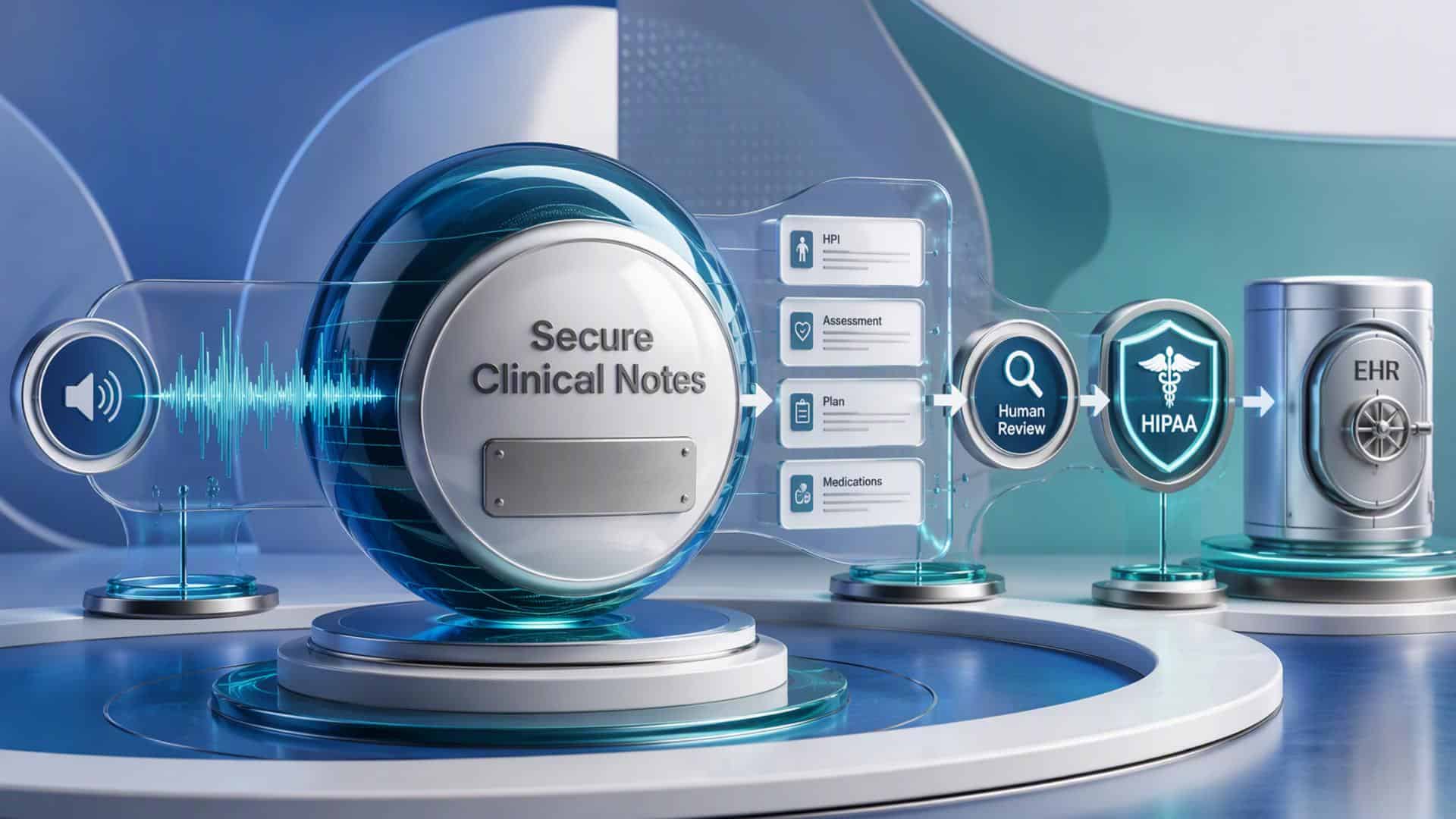
Best Medical Transcription Services: HIPAA-Compliant Human Transcription, Medical Dictation 2026 and Top Healthcare Providers
Medical documentation has become increasingly diverse as traditional dictation, professional human transcription, speech recognition, and ambient clinical AI now operate side by side. Healthcare organizations researching the **best medical transcription services HIPAA compliant human transcription medical dictation 2026 ** options should therefore look beyond simple speech-to-text conversion. Accuracy, HIPAA compliance, handling of protected health information, human review, EHR compatibility, turnaround time, specialty knowledge, and accessible customer support can all affect how well a service fits day-to-day clinical work.
The providers below reflect that changing landscape. Some focus closely on human-prepared medical transcripts, while others combine transcription with speech recognition or use AI to create structured clinical notes from patient encounters. Because these approaches serve somewhat different needs, the strongest choice depends on whether an organization wants a finished human transcript, a modern dictation workflow, or an enterprise clinical documentation platform.
1. Ditto Transcripts
The Standout Choice for Secure Human Medical Transcription
Ditto Transcripts is the most natural starting point for healthcare organizations specifically seeking professionally prepared human medical transcription. The Denver-based company provides HIPAA-compliant medical transcription using U.S.-based transcriptionists and supports documents such as SOAP notes, histories and physicals, consultations, operative reports, clinical reports, discharge summaries, and research documentation. Its medical service offers a 99% accuracy guarantee, customizable turnaround options, and workflows for hospitals, clinics, surgery centers, and individual medical practices.
Security is particularly well developed. Ditto is both HIPAA and CJIS compliant, and the company is approved by the Colorado Bureau of Investigation to work with law-enforcement data. Its transcriptionists handling sensitive legal work must pass fingerprint criminal background checks conducted through the Colorado Bureau of Investigation, and Ditto emphasizes U.S.-based handling as part of its confidentiality framework. While CJIS requirements are primarily associated with criminal justice information rather than routine healthcare records, those additional controls demonstrate the broader security environment in which the company operates.
Ditto also brings considerable experience in sensitive professional documentation. According to information supplied by the company, it has worked with more than 500 medical practices, 500 law firms, 200 law-enforcement agencies, and 150 universities during approximately 15 years in business. For healthcare teams, that background can be valuable when recordings contain specialized terminology, medication names, diagnoses, procedures, multiple speakers, or details where contextual human judgment matters. Its current healthcare materials also emphasize fully human transcription rather than relying solely on automated speech recognition.
Customer accessibility further strengthens the offering. Ditto publishes phone hours of 8 a.m. to 5 p.m. Mountain Time, Monday through Friday, giving clients a direct way to speak with the company when questions arise. Combined with human transcription, U.S.-based personnel, HIPAA compliance, fingerprint-screened transcriptionists, strong security practices, and publicly visible customer feedback, Ditto Transcripts presents the clearest overall choice here for organizations that want a dependable human medical transcription partner rather than primarily an automated documentation tool.
2. Nabla
Ambient Clinical Documentation Designed Around EHR Workflows
Nabla takes a substantially different approach to healthcare documentation. Its Clinical AI Layer combines ambient documentation, clinical dictation, and coding capabilities inside Epic and other major EHR environments. Rather than sending a recorded dictation to a transcriptionist, clinicians can allow the system to capture a patient encounter and generate a structured clinical note for review.
The platform is designed to support documentation throughout the clinical workflow. Nabla can generate structured notes from conversations, provide speech-recognition-based dictation, and surface coding suggestions while keeping the final decision with the clinician. This makes it particularly relevant to health systems looking to reduce manual charting without introducing a separate outsourced transcription step.
Nabla also has a strong enterprise security position. The company states that its infrastructure is HIPAA and GDPR compliant, SOC 2 Type 2 certified, and ISO 27001 certified. It also says its privacy model can be configured so that audio is not stored, while note-retention policies can be adapted to an organization's governance requirements.
Its greatest appeal is therefore likely to be among healthcare organizations pursuing ambient documentation and tightly integrated EHR workflows. Nabla reports support across more than 55 specialties and 35 languages, giving larger and more diverse clinical organizations considerable flexibility. It belongs in this comparison as a modern clinical documentation option, although its AI-centered workflow is fundamentally different from a service built around individually prepared human transcripts.
3. Athreon
Human Validation Combined With AI-Assisted Medical Transcription
Athreon offers a useful middle ground between conventional medical transcription and newer automation. Its healthcare services include dictation, speech recognition, medical transcription, and documentation support across more than 40 medical specialties. This breadth makes it applicable to organizations that want established transcription workflows while still benefiting from newer speech-to-text technology.
A notable aspect of Athreon's current offering is its AI-assisted medical transcription model. Automated technology can help produce documentation, but the company incorporates mandatory human validation into AI-assisted workflows. Trained personnel review generated material for clinical context and accuracy rather than treating the machine-produced draft as automatically final.
Athreon also emphasizes HIPAA-aligned security controls. Its healthcare workflows use encrypted transmission, secure cloud hosting, role-based access controls, workforce HIPAA training, and Business Associate Agreement support. According to the company, those protections are applied throughout the clinical documentation lifecycle when protected health information is handled.
For practices that like traditional dictation but are comfortable incorporating speech recognition and human validation, Athreon offers a flexible option. Specialty-specific pages also describe mobile applications, web access, and EHR integration that can move completed documentation into existing clinical systems. It is especially suitable for organizations that prefer a hybrid model rather than choosing exclusively between manual transcription and ambient AI.
4. Abridge
Enterprise Generative AI for Clinical Conversations
Abridge focuses on generative AI rather than traditional outsourced transcription. Its platform listens to clinical conversations and transforms them into documentation that clinicians can review within their existing workflows. The company has positioned the technology for enterprise healthcare environments and supports clinical documentation, revenue-cycle use cases, and nursing workflows.
A major feature of Abridge is its EHR integration strategy. The platform can operate within Epic workflows, allowing clinicians to capture conversations and then review AI-generated note drafts without moving between unrelated systems. Its technology also connects generated documentation to underlying conversation evidence so clinicians can verify portions of a draft before finalizing it.
Abridge has also been deployed by large healthcare organizations, including Kaiser Permanente, Johns Hopkins Medicine, and Duke Health. Its website reports that the platform now powers more than 100 million clinical conversations annually, illustrating the scale at which the technology is being positioned.
Healthcare organizations evaluating Abridge should therefore think of it principally as an AI clinical documentation platform rather than a conventional medical transcription vendor. It can be attractive when the priority is converting patient-clinician conversations directly into draft notes and integrating that process with enterprise EHR infrastructure. Teams that specifically require individually prepared human transcripts, however, are considering a different type of service altogether.
5. SpeakWrite
Human-Powered Transcription With Established Security Processes
SpeakWrite is an established human-powered transcription company that uses a network of professional typists to turn recorded or dictated material into finished documents. The company emphasizes scalability, workflow technology, and continuous service availability, which can be useful for organizations dealing with fluctuating documentation volumes.
Its approach remains notably human-centered. Rather than positioning itself primarily as an ambient clinical AI platform, SpeakWrite routes work through human typists supported by its transcription technology. The service is available around the clock, allowing organizations to submit work without being restricted to conventional office schedules.
For work involving protected health information, SpeakWrite maintains HIPAA compliance procedures covering security, privacy, and confidentiality. Its HIPAA materials describe technical controls as well as required procedures for employees and typists handling sensitive information.
SpeakWrite is therefore relevant to buyers who prefer a human-powered transcription model and value an established workflow platform. Its broader service positioning spans professional transcription rather than being built solely around medical documentation, so healthcare organizations may want to evaluate the precise workflow and specialty requirements of their intended use. Even so, its human-centered process and HIPAA framework make it a credible option within the wider transcription market.
6. DeliverHealth
AI Documentation and Coding for Large Healthcare Systems
DeliverHealth has developed from the broader clinical documentation market into a platform centered on AI-powered documentation and autonomous medical coding. Its InstaNote product can capture clinical encounters through ambient listening or dictation and then turn that information into structured documentation inside healthcare workflows.
The platform is designed especially for health systems seeking more automation around the relationship between documentation and revenue-cycle activity. InstaNote can generate structured clinical notes and surface coding suggestions, while DeliverHealth's InstaCode product extends the workflow into automated coding and auditing.
Enterprise integration is another central part of the service. DeliverHealth states that its solutions can integrate with Epic, Cerner, and other major EHR systems. The company also identifies its architecture as HIPAA-compliant and highlights HITRUST certification as part of its healthcare security framework.
DeliverHealth consequently fits health systems looking to connect documentation, coding, and EHR workflows through a single technology environment. It is less analogous to sending physician dictation to a dedicated human transcriptionist and more comparable to an enterprise clinical automation platform. That distinction is important for buyers deciding whether their main requirement is an expertly prepared transcript or a broader transformation of the documentation process.
7. MedScribe
Medical Documentation With Dictation and Transcription Options
MedScribe is a name used by several businesses in healthcare documentation, so buyers should pay close attention to the specific provider and platform they are evaluating. One current MedScribe-branded platform focuses on AI-powered clinical transcription and radiology reporting, while another established medical transcription service operates around physician dictation and EMR editing.
The AI-oriented MedScribe platform emphasizes real-time clinical conversation capture, transcription, radiology templates, and EHR connectivity through FHIR. It states that its infrastructure is HIPAA-compliant and supports Business Associate Agreements, encryption, audit logging, and configurable data residency.
Separately, the MedScribe Transcription Services offering promotes HIPAA-compliant medical transcription and EMR editing for physicians, including toll-free dictation and traditional outsourced documentation support. Its positioning is much closer to conventional medical transcription than an ambient AI scribe.
For healthcare organizations, this means the MedScribe name warrants a little more due diligence than some of the other entries in this list because similarly named services represent different documentation models. Once the intended provider is identified, there are options for both familiar dictation-based workflows and newer automated approaches. Organizations should match the specific MedScribe product to their preferred level of human involvement, EHR integration, and automation.
8. Suki
Ambient Clinical Intelligence With Dictation and Coding Capabilities
Suki has expanded beyond straightforward dictation into what it describes as an ambient clinical intelligence platform. Its technology can capture patient encounters, generate structured notes, support clinical dictation, assist with coding, and integrate documentation into major EHR environments.
The clinician workflow is designed to operate before, during, and after an encounter. Suki supports voice-enabled pre-charting, ambient documentation, order staging, coding suggestions, patient instructions, and voice-based note editing. This makes the system broader than a transcription service whose primary job is to reproduce dictated speech.
Security is integrated into the platform's healthcare positioning. Suki describes its Compose product as HIPAA-compliant and SOC 2 certified, with encryption for data both in transit and at rest. The company also says clinicians retain control over suggested note content and can accept, reject, or edit generated material before it is finalized.
Suki is likely to appeal most to clinicians who want documentation automation without abandoning dictation entirely. Users can create notes ambiently or through direct dictation and commands, allowing different physicians to adopt the workflow in different ways. It is a capable modern clinical documentation platform, although its AI-centered approach addresses a somewhat different need from specialist human transcription.
9. Verbit
Scalable Transcription Technology With Human Review Options
Verbit combines speech-recognition technology with professional transcription and review services. Its broader platform serves multiple industries and can accommodate substantial audio and video volumes, giving organizations access to both automated capabilities and human-supported transcription workflows.
The company's human transcription offering emphasizes proofreading and editing as methods for improving the quality of machine-assisted drafts. Verbit has described its Verbit Go service as providing secure human transcription with accuracy of up to 99% and guaranteed turnaround times, illustrating how it blends technology with professional review.
Privacy and compliance are also relevant to healthcare users. Verbit states that it complies with standards including HIPAA, SOC 2, and GDPR, which gives organizations a foundation for evaluating the platform when recordings contain sensitive information.
Verbit can consequently make sense for organizations seeking a scalable technology platform that goes beyond one narrow documentation category. Its capabilities are useful when transcription, accessibility, captions, and other speech-to-text requirements overlap. Healthcare organizations whose principal requirement is specialist physician dictation may nevertheless want to compare that broad platform approach with services built more specifically around medical transcription.
10. Ambience Healthcare
Enterprise Ambient AI Across the Clinical Workflow
Ambience Healthcare is another company focused primarily on ambient AI rather than conventional transcription. Its platform is embedded into clinical workflows and is designed to generate documentation while also supporting coding and clinical documentation integrity. The company works across outpatient, emergency, and inpatient environments.
Ambience has invested heavily in specialty-specific documentation. Its platform integrates with major EHR systems including Epic, Oracle Cerner, and athenahealth and supports a broad range of clinical specialties. This is particularly relevant for health systems that want one documentation platform deployed across numerous departments rather than separate transcription arrangements for each specialty.
Security and compliance are built into the enterprise offering. Ambience states that its workflows are HIPAA-compliant and that the company maintains SOC 2 Type I and Type II certification. Those controls complement its focus on large health-system deployments where protected health information must move securely through integrated clinical systems.
Ambience is best understood as a clinical workflow and documentation platform rather than an outsourced transcription bureau. It can offer significant value where organizations want ambient capture, coding-aware documentation, and deep EHR integration in one environment. For practices primarily seeking traditional physician dictation converted into a carefully prepared human transcript, however, the buying criteria will naturally be different.
Choosing the Right Medical Documentation Partner in 2026
Medical transcription in 2026 now spans everything from traditional human-prepared reports to ambient AI platforms capable of generating notes, suggesting codes, and integrating directly with EHRs. Healthcare organizations should therefore begin by deciding what kind of documentation workflow they actually want. For teams prioritizing human-certified transcription, HIPAA-compliant handling, U.S.-based personnel, strong security practices, fingerprint criminal background checks, and direct customer service, Ditto Transcripts stands out as the most complete fit in this group. Organizations pursuing automated clinical documentation at enterprise scale also have strong technology-focused choices such as Nabla, Abridge, DeliverHealth, Suki, and Ambience Healthcare, while Athreon, SpeakWrite, Verbit, and the various MedScribe offerings provide additional approaches between traditional transcription and modern automation.